


 English
 Español
Looking forward to your message
Our factory was established in 2006
-
 Mobile/Whats app/Wechat: +86-18761594570 ( Miss. Jenny Chen )
-
 E-mail: [email protected]
POF Shrink Wrap Film: Properties, Grades & Application Guide
Content
- 1 POF Shrink Wrap Film Is the Most Versatile and Widely Used Shrink Packaging Material for Retail and Commercial Applications
- 2 How POF Shrink Film Works: The Science of Biaxial Orientation
- 3 POF Shrink Film vs PVC and PE Shrink Film: Why POF Wins in Most Applications
- 4 POF Shrink Film Grades, Gauges, and Formats
- 5 Equipment Required to Run POF Shrink Wrap Film
- 6 Key Industries and Applications for POF Shrink Film
- 7 Technical Specifications to Evaluate When Selecting POF Shrink Film
- 8 Common POF Shrink Wrapping Problems and How to Resolve Them
- 9 Sustainability and Recyclability of POF Shrink Film
POF Shrink Wrap Film Is the Most Versatile and Widely Used Shrink Packaging Material for Retail and Commercial Applications
POF shrink wrap film — polyolefin shrink film — is a multi-layer, biaxially oriented thermoplastic film that shrinks tightly around a product when heat is applied, creating a clear, glossy, tamper-evident package. POF has become the dominant shrink wrap material in retail packaging, food bundling, cosmetics, toys, stationery, and software packaging, displacing PVC shrink film in most markets over the past two decades due to its superior clarity, food-contact safety, lower sealing temperatures, and absence of the toxic hydrogen chloride gas that PVC releases when heated.
POF shrink film is produced from polyolefin resins — primarily polyethylene (PE) and polypropylene (PP) co-extruded in multiple layers — and biaxially oriented (stretched in both machine and transverse directions) to build in the molecular memory that causes it to shrink when exposed to heat. The result is a film that is tougher, clearer, and more flexible than single-layer materials, capable of wrapping products of virtually any shape with professional results on both manual and high-speed automated lines.
How POF Shrink Film Works: The Science of Biaxial Orientation
Understanding what happens inside POF film during manufacturing and during shrinking explains why it behaves so differently from ordinary polyethylene film and why process parameters matter so much for consistent results.
Biaxial Orientation and Molecular Memory
During manufacturing, the co-extruded polyolefin film is stretched simultaneously or sequentially in both the machine direction (MD) and the transverse direction (TD) at a temperature above the resin's glass transition point but below its melting point. This orientation aligns and stretches the polymer chains in both directions. When the film cools, the chains are locked in this stretched state — storing elastic energy at the molecular level. When the oriented film is reheated above its orientation temperature during shrink packaging, the polymer chains relax back toward their original configuration, causing the film to shrink by 30–80% in each direction depending on the film grade and the heat applied.
The degree of orientation — and therefore the amount of shrinkage and shrink force — is controlled during manufacturing by the stretch ratios applied. Most standard POF shrink films are oriented to a stretch ratio of approximately 5:1 to 7:1 in both directions, producing films with balanced (equal MD and TD) shrink of 50–75% at full activation temperature. Centrefold and single wound films for L-bar and side-sealers are manufactured with specific MD-to-TD shrink balances to optimise the wrap appearance on different product geometries.
Multi-Layer Co-Extrusion Structure
Commercial POF shrink films are not monolithic — they are co-extruded multi-layer structures, typically 3 or 5 layers, where different resin types in different layers provide distinct properties. A typical 3-layer POF structure uses:
- Outer skin layers (PP-based): Provide clarity, gloss, and mechanical protection. PP also contributes to the film's stiffness and printability.
- Core layer (PE-based): Provides toughness, flexibility, and the primary heat-seal properties. PE gives POF its excellent low-temperature sealability and resistance to tearing during high-speed wrapping.
5-layer structures add additional tie layers or functional layers — anti-fog properties for food packaging, anti-static layers for electronics, or enhanced barrier properties for moisture-sensitive products. The total film thickness for commercial POF shrink films ranges from 12 to 25 microns for standard retail applications, with speciality grades up to 35 microns for heavier products or premium presentation packaging.
POF Shrink Film vs PVC and PE Shrink Film: Why POF Wins in Most Applications
POF did not replace PVC and PE shrink films by accident — it offers a combination of performance properties that neither alternative matches across the full range of packaging requirements.
| Property | POF (Polyolefin) | PVC (Polyvinyl Chloride) | PE (Polyethylene) |
|---|---|---|---|
| Optical clarity | Excellent (haze <2%) | Good | Moderate to poor |
| Shrink range (% at activation) | 30–80% | 20–60% | 10–40% |
| Sealing temperature | Low (120–150°C) | Medium (140–170°C) | Medium–high (150–180°C) |
| Food contact safety | Yes (FDA, EU compliant) | Restricted (plasticisers) | Yes |
| Toxic fumes when sealed/shrunk | None | HCl and dioxins | None |
| Tear resistance / toughness | High | Low–medium (brittle) | High |
| Performance at low temperatures | Excellent (stays flexible) | Poor (brittle below 0°C) | Good |
| Recyclability | Yes (polyolefin stream) | Difficult (contaminates streams) | Yes |
| Relative material cost | Medium | Low | Low |
PVC shrink film's low cost made it the industry standard through the 1980s and 1990s, but the hydrogen chloride gas released when PVC is sealed and shrunk corrodes sealing wires and heating elements, creates an unpleasant working environment, and is classified as a health hazard requiring ventilation — operational costs that erode its material cost advantage. Many countries and major retailers have moved to requiring POF for retail-ready packaging, effectively ending PVC's viability in consumer goods markets.
POF Shrink Film Grades, Gauges, and Formats
POF shrink films are available in a range of thicknesses, shrink ratios, and physical formats to match different products, machines, and throughput requirements.
Film Thickness (Gauge)
Film thickness is specified in microns (µm) or gauge (where 100 gauge = 25.4 µm). The most widely used thickness range for retail and commercial POF shrink film is 15–19 microns (60–75 gauge), which provides adequate strength for most products while minimising film consumption per package. Thicker films are used for heavier, sharper, or more abrasive products:
- 12–15 µm (47–60 gauge): Very lightweight film for small, smooth-surfaced products such as playing cards, small stationery, and single-serve food items. Minimises material cost per unit but offers less puncture resistance.
- 15–19 µm (60–75 gauge): Standard all-purpose range. DVDs, books, cosmetics, boxed foods, gift sets, and general retail products. Most cost-effective for medium-volume automated lines.
- 19–25 µm (75–100 gauge): For products with sharp edges, heavy weights, or abrasive surfaces — hardware items, metal-cornered boxes, canned goods multipacks. Higher tear initiation resistance reduces in-transit damage.
- 25–35 µm (100–138 gauge): Heavy-duty grade for industrial bundling, large multipack consolidation, and products subject to rough handling. Usually run on heavy-duty L-bar sealers or sleeve wrappers rather than lightweight retail machines.
Film Formats: Centrefold vs Single Wound
POF shrink film is supplied in two main physical formats that correspond to different sealing machine types:
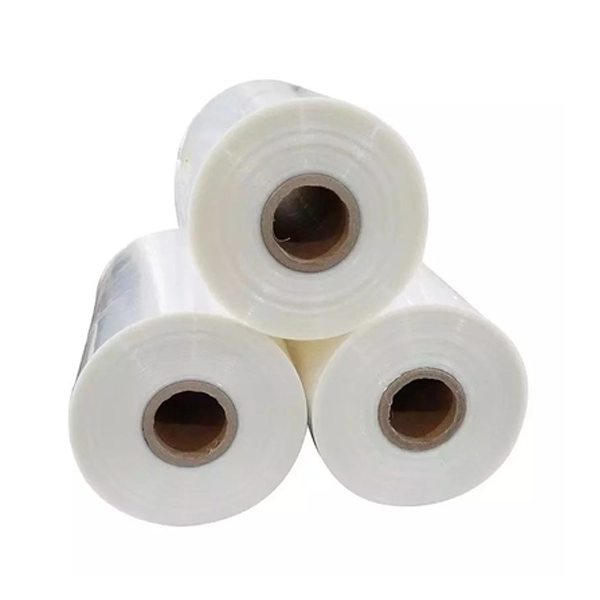
- Centrefold (folded flat): The film is folded lengthwise at the centre and wound onto a core with two layers. The product is inserted into the folded film, and a single L-shaped seal closes the open sides. Used with L-bar sealers, the most common shrink wrapping machine type for retail applications. Centrefold widths of 300–700 mm cover the majority of retail product sizes.
- Single wound (lay-flat): A single layer roll used with sleeve wrappers (also called side-seal or continuous motion wrappers) that form a tube around the product. More efficient for high-speed automated lines — sleeve wrappers with POF single-wound film can achieve throughput rates of 60–120 packs per minute on packaging lines for food, beverages, and consumer goods.
Crosslinked vs Non-Crosslinked POF Film
Standard POF shrink film is non-crosslinked. Crosslinked POF film undergoes electron beam or chemical crosslinking after orientation, which creates molecular bonds across the polymer chains — significantly increasing puncture resistance, hot strength (the film's resistance to tearing during the sealing operation), and the quality of the shrunk appearance around complex shapes. Crosslinked POF film is 30–50% more expensive than standard grades but is specified for premium presentation packaging, unusually shaped products, products with sharp or protruding edges, and applications where the wrap must conform very tightly to detailed surface geometry. It is also easier to seal at very high speeds without the risk of the film blowing out at the seal during the sealing operation.
Equipment Required to Run POF Shrink Wrap Film
POF shrink film requires two distinct pieces of equipment to produce a finished package: a sealer to wrap and seal the film around the product, and a shrink tunnel to apply heat and activate the shrink. The sealer and tunnel must be matched to each other, to the film grade, and to the product being packaged.
L-Bar Sealers
L-bar sealers (also called L-sealers) use an L-shaped heated wire or blade that simultaneously seals and cuts along two sides of the package in a single motion — one cut across the front of the product and one along the side. The product is placed on the film, the L-bar is lowered, and the two open sides are sealed and trimmed in one action. L-bar sealers are used exclusively with centrefold film. Manual and semi-automatic L-bar sealers are the most common shrink packaging equipment for low-to-medium volume applications — speeds of 5–20 packs per minute depending on operator skill and product size. Fully automatic L-bar sealers with integrated conveyor feeding achieve 20–50 packs per minute.
Sleeve Wrappers (Side-Seal and Horizontal Flow Wrappers)
Sleeve wrappers form a continuous tube of single-wound POF film around a moving product stream, then apply cross seals to close the ends of each individual package. Products are conveyed through the machine continuously, and the seal and cut cycle is timed to the product pitch. Sleeve wrappers are faster, more consistent, and more suitable for integration into automated production lines than L-bar sealers, but require higher capital investment (£10,000–£80,000+ for automatic sleeve wrappers vs £500–£5,000 for semi-automatic L-bar sealers) and single-wound rather than centrefold film.
Shrink Tunnels
After sealing, the wrapped (but not yet shrunk) product passes through a shrink tunnel — an enclosed chamber with heated air circulated at controlled temperature and velocity. The heat activates the biaxial orientation in the POF film, causing it to shrink tightly around the product. POF shrink films typically activate at tunnel temperatures of 120–160°C (250–320°F), significantly lower than PE shrink films (which may require 180–200°C) — an energy efficiency advantage for POF. Tunnel belt speed, air temperature, and air circulation velocity must be balanced to achieve full, even shrink without burning holes in the film or producing a wrinkled, distorted appearance.
Hot air tunnels are the universal standard for POF film. Infrared (IR) shrink tunnels are used for heat-sensitive products — cosmetics with labels, chocolate boxes, products that cannot tolerate prolonged air heat exposure — because IR activates the shrink more rapidly with less residual heat transferred to the product. Steam tunnels are used for specific food and beverage applications where moisture control is needed alongside shrinking.
Key Industries and Applications for POF Shrink Film
POF shrink film's combination of clarity, food safety, toughness, and processing versatility has made it the default packaging material across a remarkably wide range of industries.
Food and Beverage Packaging
Food-grade POF shrink film is used for fresh produce trays, baked goods, confectionery, ready meal trays, multipack beverages, and dairy product bundling. Anti-fog POF film — with a coating that prevents water vapour from condensing as opaque droplets on the film surface — is essential for chilled and refrigerated food displays where consumer visibility of the product through the film is required. Anti-fog POF maintains clarity even when the film moves from cold storage to ambient retail temperature. Food-contact compliance under EU Regulation 10/2011 and FDA 21 CFR is standard for reputable POF film manufacturers.
Retail and Consumer Goods
DVDs, Blu-rays, video games, books, stationery, cosmetics, toys, gift sets, and electronics accessories are among the largest volume retail applications for POF shrink film. The crystal clarity of POF allows full product visibility and printed label legibility through the wrap, while the tight, professional appearance signals quality and provides tamper evidence. Retailers including major supermarkets and online fulfilment operators specify POF for pre-pack operations because its low sealing temperature reduces the risk of heat damage to printed labels, foil embossing, and heat-sensitive product components that PVC's higher temperatures can damage.
Pharmaceuticals and Medical Products
POF shrink film provides tamper-evident overwrapping for pharmaceutical boxes, vitamin and supplement bottles, medical device kits, and hospital supply bundles. The film serves as a visible tamper-evident seal — any attempt to open the package before purchase destroys the shrink wrap in an obvious, irreversible way. Pharmaceutical-grade POF films are produced under GMP conditions and documented to USP and EU pharmacopoeia standards for extractables and leachables, ensuring that no harmful substances migrate from the film into the product during storage.
Multipack Bundling and Logistics
POF shrink film is used to bundle multiple individual items into retail-ready multipacks — beverage multipacks, multipack paper products, and bundled canned or jarred goods. In this application, the film acts as both a carrier (holding the items together for handling and display) and a promotional medium, since the film can be printed with promotional messages, brand logos, and pricing information. Heavier gauge POF (19–25 µm) is typically specified for multipack bundling to withstand the weight and handling demands of the application.
Technical Specifications to Evaluate When Selecting POF Shrink Film
Choosing the correct POF film grade for a specific application requires evaluating several technical parameters. Using an under-specified film causes packaging failures; over-specifying increases cost without benefit.
- Shrink percentage (MD and TD): The percentage of dimensional reduction in each direction at a specified temperature. Balanced shrink (equal MD and TD) is preferred for most rectangular products; films with higher TD shrink are specified for products that are taller than they are wide, to ensure the film pulls tight over the top surface without puckering at the ends.
- Shrink initiation temperature: The temperature at which significant shrinkage begins. Lower initiation temperature allows the tunnel to run at lower temperature settings — an energy saving and a protection for heat-sensitive products. Standard POF initiates at 95–110°C; low-temperature grades begin shrinking at 80–90°C.
- Haze (optical clarity): Measured as percentage of scattered transmitted light. Premium POF films achieve haze values below 1.5–2% — essentially invisible clarity. Higher haze produces a cloudy appearance that is unacceptable for luxury presentation and premium retail packaging.
- Seal strength and hot tack: The force required to peel the seal apart, and the strength of the seal immediately after sealing before it has cooled fully (hot tack). High hot tack is critical on high-speed automatic lines where the package moves through the tunnel before the seal has cooled completely.
- Puncture resistance: The energy required to puncture the film, measured per ASTM D1709 (dart drop method) or ASTM F1306 (slow puncture). Critical for products with protruding corners or sharp edges.
- Anti-static performance: Standard POF builds up static charge that attracts dust and causes films to cling on high-speed lines. Anti-static POF — with a topcoat or incorporated anti-static additive — is specified for electronics packaging and high-speed production environments.
- Printability: Some POF grades are corona-treated on one or both surfaces to achieve the surface energy required for ink adhesion. Printable POF allows branding and information to be printed directly onto the shrink film, eliminating the need for a separate paper or card label in promotional multipack applications.
Common POF Shrink Wrapping Problems and How to Resolve Them
Most defects in POF shrink-wrapped packages originate from process parameter settings rather than film defects. Understanding the root cause of each problem guides the correct adjustment.
Fish Eyes and Holes in the Shrunk Film
Small holes or melt-through spots in the finished package are caused by excessive tunnel temperature, overly aggressive air flow directed at one spot, or a film thickness that is insufficient for the shrink temperature required. Solution: reduce tunnel temperature in 5°C increments, reduce air velocity, or upgrade to a thicker gauge film. Holes near the seal area usually indicate the seal bar temperature is too high.
Wrinkled or Dog-Eared Appearance
An uneven, puckered, or dog-eared shrunk appearance indicates insufficient heat — the film has not fully activated and cannot complete the shrink cycle. Root causes include tunnel temperature too low, belt speed too high (insufficient dwell time in the tunnel), or a film grade with high shrink initiation temperature relative to the tunnel's operating range. Increasing tunnel temperature or reducing belt speed by 10–15% typically resolves wrinkling without requiring film grade changes. Dog-ears at the ends of the package specifically indicate insufficient TD shrink — either from film grade selection or inadequate heat reaching the end faces of the package.
Weak or Peeling Seals
Seals that peel open during or after shrinking indicate sealer wire/blade temperature too low, sealing dwell time too short, or film surfaces contaminated with release agents or anti-block additives. Increase sealer temperature in 5°C steps and verify dwell time. For production lines handling multiple film grades, ensure the sealer temperature profile is reset when changing to a thinner or lower-sealing-temperature film — a temperature setting appropriate for 19 µm film may produce burnt or perforated seals on 12 µm film.
Film Tracking and Feeding Problems
Film walking off-centre, inconsistent film tension, or film tearing at the unwind are usually caused by incorrect roll mounting (roll not centred on the unwind mandrel), an out-of-round or damaged film roll core, or excessive unwind brake tension. Storing POF film rolls on end (vertically) causes core deformation and uneven tension distribution — always store rolls horizontally on their core, on padded support racks, and away from direct heat sources that can cause partial pre-shrinkage of the outer film layers.
Sustainability and Recyclability of POF Shrink Film
The environmental profile of POF shrink film is more nuanced than a simple assessment of it being a single-use plastic. Several characteristics of POF make it one of the more sustainable flexible packaging options available — but real limitations remain.
Recyclability in Polyolefin Streams
POF shrink film is chemically compatible with polyolefin recycling streams — it can in principle be recycled alongside LDPE (low-density polyethylene) film in film collection schemes. In the UK, POF is accepted in the soft plastics recycling collections operated by major supermarkets (Carrier Bag recycling points); in the US, it is accepted at PE film collection points at participating retailers. The practical challenge is that mixed-material POF (with PP-based outer layers and PE core) is harder to recycle than mono-material PE film — the PP and PE components have different melting points, requiring compatibilisers or specific reprocessing conditions to produce a usable recyclate.
Downgauging: Less Film per Package
One of the most effective sustainability improvements in POF packaging is downgauging — using a thinner film that still performs adequately for the application. Advancing POF technology has allowed average film gauge to reduce from 19–25 µm in the 1990s to 12–15 µm for many standard retail applications today, reducing plastic consumption per package by 30–40% without performance compromise. Further downgauging to 10–12 µm ultra-thin grades is available for the lowest-demand applications.
Bio-Based and Compostable POF Alternatives
Several manufacturers are developing biaxially oriented shrink films from bio-based polyolefins (PE derived from sugarcane ethanol) and from compostable polymers (PLA-based shrink films). Bio-based PE has identical performance to petroleum-based PE and is fully recyclable in the same streams. PLA-based shrink films are industrially compostable but have inferior shrink range and clarity compared to POF, limiting their applicability to niche products where compostability certification is a specific market requirement. Bio-based POF is currently at a 15–30% cost premium over petroleum-based equivalents, with the gap narrowing as production volumes increase.
Recommended Products
Contact Us
Want To Know More?

- E-mail: [email protected]
- Phone: +86-18761594570 ( Miss. Jenny Chen )
- WhatsApp: +86-18761594570
- Address : No. 58-2, Panlongshan Road, Shanguan Town, Jiangyin City, Jiangsu Province, China
Product Categories
Follow Us
Copyright © 2025 by Jiangyin Guanghong Packing Materials Co., Ltd. Rights Reserved.
 POF Shrink Film Manufacturers